
Tennessee Correction Release Paths
The Tennessee Department of Correction operates state prisons and Field Services. Its public search is relevant to a Dyer County person only when the person entered TDOC custody or supervision. A former county detainee who never entered that system may have no FOIL record. Likewise, leaving Dyer County Jail for TDOC is a transfer, not a community release.
A state prisoner may leave confinement on parole, at sentence expiration, or through another authorized TDOC release path. Parole places the person under conditional community supervision. Probation is imposed by a court and is supervised by TDOC Field Services, but it is not parole. A later discharge or inactive status may indicate that active state custody or supervision ended, though the associated dates and archived file are needed to explain why.
Search TDOC Release Records
Felony Offender Information Lookup, known as FOIL, is the correct public starting point for current and former TDOC felony offenders. Open the official landing page, follow Search Now, accept any terms displayed, and search by name or TOMIS identifier. Narrow a common name with birth date or other fields offered by the live form. Then compare the name, TOMIS ID, birth date, and photograph before using the result.
- Begin with the person's full name or TOMIS number.
- Use available identity fields to reduce false matches.
- Open the detail and transcribe every status and date label exactly.
- Read location, sentence, offense, parole-hearing, and release information in context.
- Request archived TDOC records if the public result omits the needed endpoint.
TDOC says FOIL may contain a photo, status, location, offense, sentence information, parole-hearing status, and release information. “May” matters because fields vary by person and case. A parole or probation label means community supervision remains active. An incarcerated label means a disappearance from the Dyer jail roster was not a release to the community. Inactive status is useful, but it does not by itself explain sentence expiration, discharge, or another terminal event.
FOIL is also available through the MyTN application under Public Safety. MyTN is a state channel. It is not a Dyer County sheriff app and does not create a local recent-release list.
TDOC Release Search Fields
Read the labels shown on the live record. Do not substitute a familiar phrase for the actual field. In particular, parole eligibility, sentence expiration, and actual release are different dates. One can mark possible consideration, another the calculated sentence endpoint, and the last a completed custody event.
| Possible FOIL field | How to use it |
|---|---|
| Name, birth date, TOMIS ID, photo | Confirm the person before interpreting status. |
| Status | Distinguish incarcerated, parole, probation, or inactive. |
| Location | Identify an institution or supervision setting when shown. |
| Offense and sentence | Connect the status to the controlling state sentence. |
| Parole-hearing status | Shows a hearing-related state, not guaranteed release. |
| Release information | Use the exact date and event label displayed. |
The official TDOC FOIL explanation is shown in this captured source.
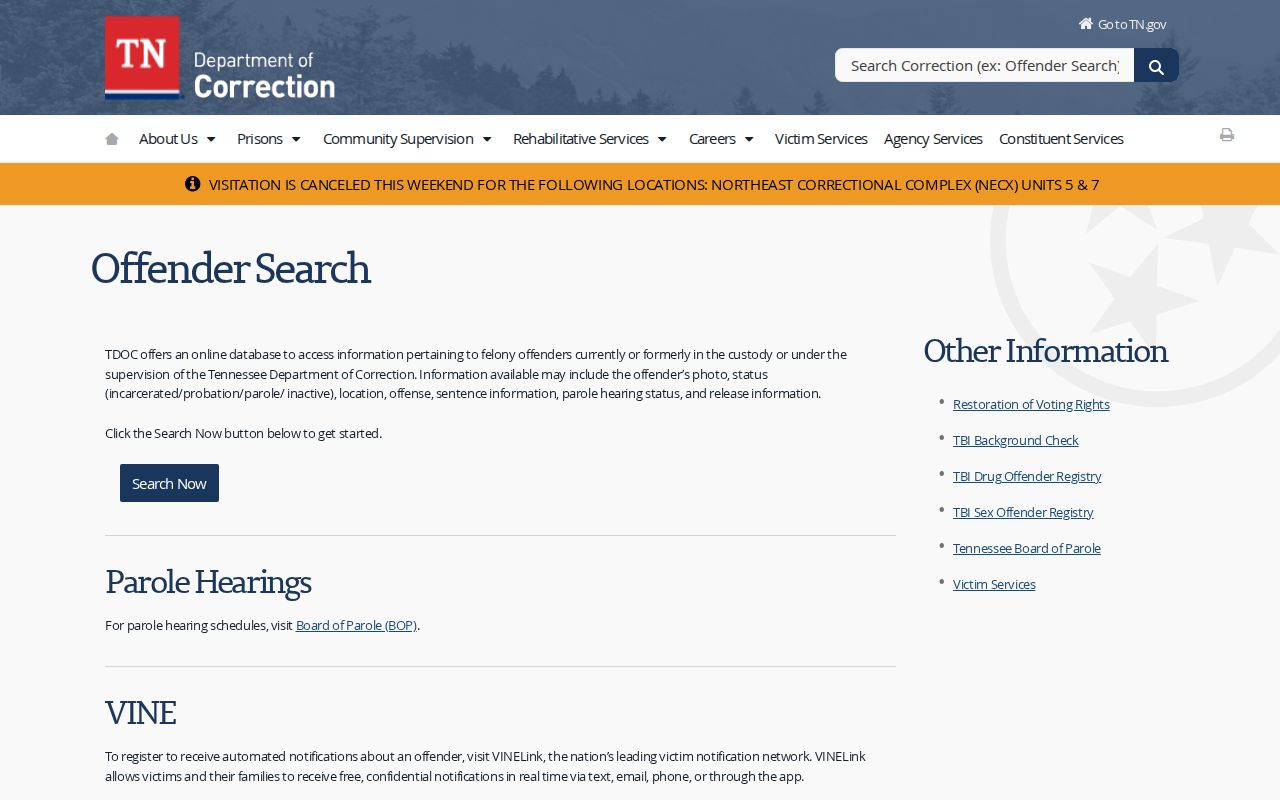
The official page confirms coverage of current and former felony offenders and points to the state search, while individual fields still depend on the matched record.
Note: A future eligibility date is not a promise that the person will leave custody on that day.
TDOC Archived Release Records
If FOIL lacks a historical field, use the TDOC archived-record request. The state asks for requester contact details, the reason for the request, the offender's full name, TOMIS number, birth date, Social Security number, and a detailed description. A requester may not possess every identifier, so provide what is lawfully available and ask TDOC what is sufficient.
TDOC Records ManagementRachel Jackson Building, Second Floor
320 Sixth Avenue North
Nashville, TN 37243-0465
615-253-8079
Useful existing records can include the release authorization, sentence-calculation summary, arrival and departure history, release certificate, parole certificate, and discharge or expiration notation. Ask for the specific records that answer the question. TDOC says archive-search charges may apply and instructs requesters not to send payment first because charges are communicated after the search.
Records can be withheld or redacted under lawful exemptions. Tennessee public-records access does not require an agency to create a new narrative or custom calculation. The archived file is especially useful when FOIL shows inactive status but does not reveal whether supervision ended, the sentence expired, or another event closed the record.
Dyer County TDOC Handoffs
The Dyer County release search path starts with the actual custodian. A Dyersburg officer may make an arrest, and Dyer County Jail may hold the person. If the sheriff later transfers the person to TDOC, the county booking closes while state custody starts. Search FOIL after intake data has had time to post, and retain the sheriff's transfer date and destination so the two records can be reconciled.
| Event | Controlling record |
|---|---|
| Dyer arrest and booking | Police record plus sheriff booking |
| Transfer from county jail | Sheriff release or movement entry |
| TDOC intake and confinement | FOIL and state arrival history |
| Parole decision | Tennessee Board of Parole record |
| Parole or probation supervision | TDOC Field Services and FOIL |
| Release or final discharge | FOIL release information and archived TDOC file |
The Board of Parole makes eligible parole decisions, while TDOC supervises parole and probation. A grant, certificate preparation, and actual departure are separate events. Release-plan approval, detainers, recalculation, or administrative work can intervene. Do not treat a Board decision date as the jail or prison door time unless the custody record confirms it.
Dyer and Lauderdale community supervision is served by TDOC District 61 at 2155 St. Johns Avenue in Dyersburg, with the published phone 731-288-7910. That office concerns supervision. Archived custodial records still belong through TDOC Records Management.
TDOC Release Date Meaning
Tennessee release dates depend on the actual judgment and state calculation. Tenn. Code Ann. § 40-35-501 contains offense- and date-specific release eligibility rules, while § 41-21-236 concerns sentence-reduction credits. Some convictions have 85 percent or 100 percent service rules, while other rules apply elsewhere. There is no sound universal 85 percent formula.
- Release eligibility
- A point when consideration or eligibility may arise under the governing law.
- Sentence expiration
- The calculated end of the sentence, subject to authoritative adjustments.
- Actual release
- The completed event when incarceration ends or changes to supervision.
- Parole
- Conditional release from incarceration under Board authority and TDOC supervision.
- Discharge
- The end of the controlling correctional term or supervision status.
Credits, disciplinary action, jail credit, resentencing, new sentences, and detainers can affect the calculation. The conviction offense, offense date, sentence range, judgment percentage, and concurrent or consecutive structure all matter. A records researcher should not calculate a date from a charge description alone.
Note: The judgment and TDOC sentence calculation control, not a date estimator or a generalized percentage.
Verify a TDOC Discharge
For a strong release conclusion, match the person first, identify the exact state status, and locate actual release information. If the result says parole or probation, describe community supervision rather than unconditional freedom. If it says inactive, inspect all dates and sentence rows and use archived records when the endpoint matters. If it says incarcerated, continue with the listed state location or TDOC contact.
Compare the state result with the Dyer County source only when the same custodial episode crossed systems. A county release record that says transfer to TDOC and a later FOIL intake reinforce each other. The jail record alone cannot establish a later state-prison release. FOIL alone does not establish what happened in a separate Dyer misdemeanor arrest.
When data conflicts, note the time checked and the jurisdiction each source controls. VINE can add notice of a release or transfer, but it depends on agency feeds and is not the legal release certificate. A court judgment explains authority. The custody and discharge records establish execution.
The final description should use narrow words such as transferred to TDOC, released from state incarceration to parole, completed a TDOC sentence, or discharged from supervision. Those phrases preserve the difference between prison, supervision, and the end of all state correctional control.
Review TDOC Release Proof
Before reporting the endpoint, compare the TOMIS identity, displayed status, and every sentence or release label with the archived record when one was obtained. Note whether the date is eligibility, expiration, parole, physical release, or final discharge. Those labels answer different questions and may appear together without conflict.
If FOIL omits the field needed, say so and use the archived route. Do not turn a missing date into a calculation. Keep the county transfer record separate from the later TDOC outcome, and preserve the time each public result was checked.