
Dyer Projected Versus Actual Release
A projected date is a calculation based on the information then in force. It is not a promise. Tennessee correctional records may distinguish a release eligibility date, sentence expiration, parole hearing date, projected release, and actual release. Eligibility identifies a point when statutory consideration can arise. It does not guarantee a favorable Board decision. Sentence expiration is a calculated endpoint. Actual release is the completed custody event shown by the releasing agency.
A pretrial Dyer County detainee usually lacks a sentence-based projected date. The next event may depend on bond, a new order, dismissal, plea, or trial. Even an approved bond is not proof that the person left the jail. A sentenced inmate has a calculation, but the county jail and TDOC use different authority and records. A person can also leave Dyer custody by transfer and remain confined elsewhere.
Scheduled versus actual: Use a future date only as labeled. Confirm a completed Dyer County release through the custodian's release entry, date, and destination.
The physical release date answers when custody ended at that facility. The receiving-custodian field answers whether freedom followed. A transfer to TDOC, another jail, BOP, or ICE closes one booking without creating a community release.
Four dates often appear near the same case: admission, the legal order or decision, physical release or transfer, and the database update. They need not match. A judge may sign an order before the jail completes departure steps. A Board decision can precede TDOC's physical release. VINE can post an alert after the source agency acts. Record each label and source instead of collapsing all four into one “release date.”
Find a Dyer Projected Release
Start by identifying the sovereign and last custodian. The TDOC FOIL landing page is the state-prison route. FOIL means Felony Offender Information Lookup, and it covers felony offenders currently or formerly in TDOC custody or supervision. For a Dyer County Jail sentence, the sheriff's time computation and the court judgment matter. For a federal sentence, BOP and the federal judgment control. None of those systems should be substituted for another.
- Confirm the full name, date of birth, booking or TOMIS number, court case, and current custodian.
- For TDOC, open FOIL and match the identity. Copy each sentence and release label exactly as displayed.
- For a county sentence, request the Dyer County judgment, jail-credit line, and the jail's written time computation.
- Check whether sentences run concurrently at the same time or consecutively one after another.
- Ask about a hold, detainer, revocation, new case, or amended judgment that could block the shown date.
- For a completed event, obtain the actual release or transfer record rather than relying on the old projection.
The sheriff can be reached at 731-285-2802 for the jail or records custodian. The Circuit Court Clerk can help locate the local judgment and jail-credit notation. When one named person's full county-release path is needed, the Dyer County released-inmate record search explains how custody and court records fit together.
A local court file can show bond action, judgment, sentence, jail credit, probation, revocation, and later amended orders. It cannot supply the precise jail-door timestamp unless the executed custody record is also present. Conversely, the jail's calculated date does not rewrite the judgment. Compare both records. If they disagree, ask the clerk whether an amended order exists and ask the jail which order and credit total its current computation uses.
Note: A Dyer County roster absence never supplies a projected or actual release date by itself.
Dyer Release Dates in FOIL
TDOC says FOIL may show a photograph, status, location, offense, sentence information, parole-hearing status, and release information. The word “may” matters. The fields vary by person and case. Before treating a future date as a release date, inspect its exact label. A parole hearing date is not release eligibility. An eligibility date is not sentence expiration. An inactive status does not, on its own, explain why TDOC control ended.
The official TDOC page explains the available state lookup and links to the live system. View the FOIL explanation from TDOC before opening a result.
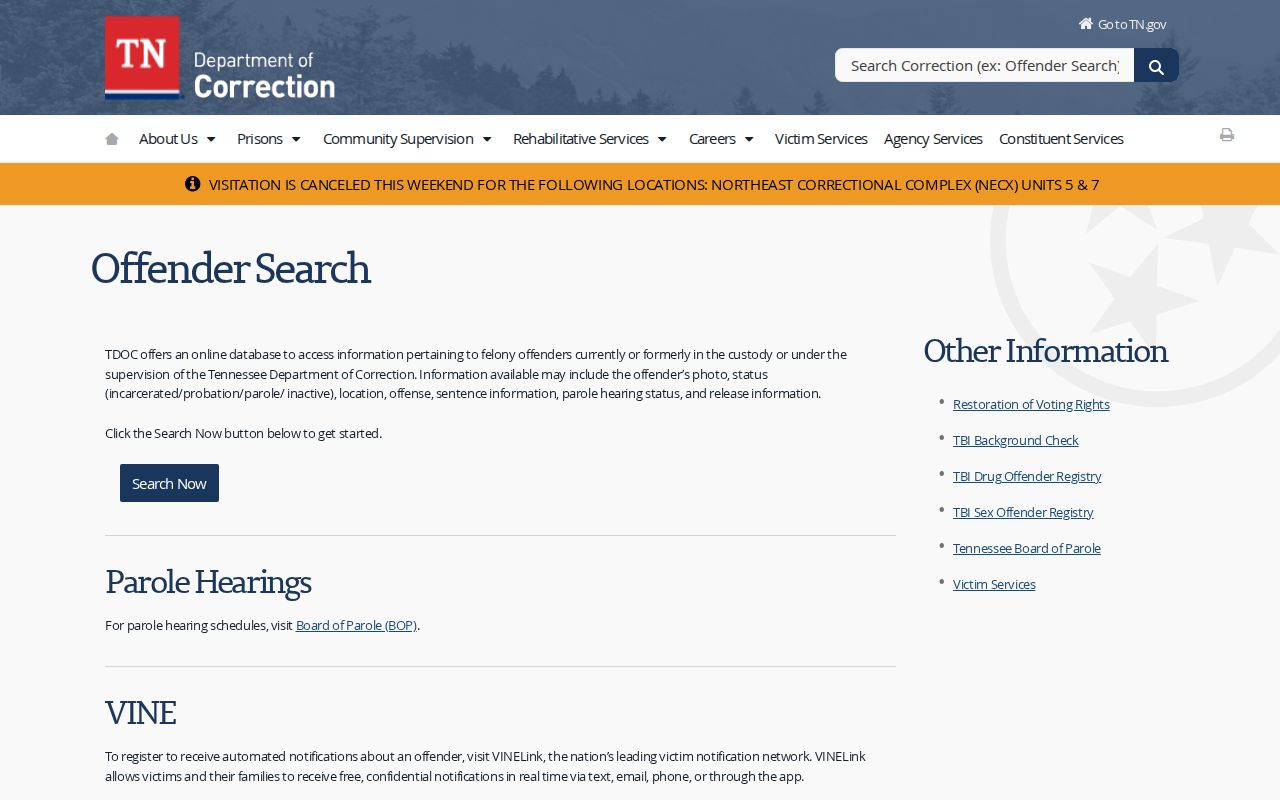
The state page establishes FOIL's current-and-former offender scope, while the matched detail record supplies the date labels for one person.
| FOIL information | How to read it |
|---|---|
| Status | Read incarcerated, parole, probation, or inactive literally and with its record date. |
| Location | Shows the displayed institution or supervision setting, when supplied. |
| Sentence information | Compare offense and sentence rows with the judgment. |
| Parole-hearing status | Describes a decision process, not a guaranteed door date. |
| Release information | Use the exact label and distinguish projected data from an actual event. |
If FOIL lacks a needed field, TDOC's archived-record request can seek the sentence-calculation summary, arrival and departure history, release authorization, release certificate, and discharge notation. Archive charges may apply, but TDOC instructs requesters not to send advance payment.
The archived request should identify the offender by full name, TOMIS number, date of birth, and other lawfully available details. Describe the exact existing record sought. TDOC requests contact information and a reason for the request, and it may ask for more identifiers before locating an older file. Written requests go to Records Management in the Rachel Jackson Building, second floor, at 320 Sixth Avenue North, Nashville, TN 37243-0465. Questions can be directed to 615-253-8079.
Tennessee Credits for Dyer Releases
Tennessee has no sound one-size-fits-all percentage calculator. Tenn. Code Ann. § 40-35-501 governs the release-eligibility framework. The applicable rule can depend on the offense, offense date, range, judgment, and later legislation. Some serious offenses carry 85 percent or 100 percent service rules and limits on which credits affect eligibility or sentence expiration. Those provisions do not make “85 percent” a universal answer.
Tenn. Code Ann. § 41-21-236 governs sentence-reduction credits. Credits can be earned, lost, or restored under governing rules. The key question is what the credit changes. It may affect release eligibility, sentence expiration, or another calculation differently. The judgment and TDOC's official calculation control, not a hand count based on a sentence headline.
TDOC Policy 511.03, Release Procedures, supplies state release-process vocabulary and requirements. Pair it with the judgment and the current calculation. A Board grant can still precede physical release because certificate work, an approved release plan, a detainer, or other prerequisites may remain.
Note: Tennessee's 85 percent rules apply only where the offense, date, judgment, and statute make them applicable.
Dyer County Release Computation Checklist
No official Dyer County good-time policy or special weekend-release schedule was verified. That absence is a material finding. A misdemeanor county sentence cannot be calculated by importing TDOC prison-credit rules. Ask the sheriff or jail administrator for the written local sentence-credit policy in force and for the inmate's actual time computation. Ask the clerk for the judgment that the jail is implementing.
The document check should be complete before a projected date is repeated:
- Sentencing judgment and each count's term
- Pretrial jail credit stated in the record
- Concurrent or consecutive sentence structure
- Applicable statutory release percentage
- Credits and any disciplinary loss or restoration
- New judgments, revocations, escapes, or detainers
- The custodian's current sentence calculation
No verified Dyer rule promises a Friday release when a date falls on a weekend. A court order or statute may control a specific case, but the door time should be confirmed with the jail. A short county sentence also may end as time served, sentence expiration, transfer, or release subject to another hold. The release entry must say which event occurred.
Pretrial jail credit deserves special care. It represents qualifying time already spent in custody and should be taken from the judgment and official computation. A rough count from the arrest date can be wrong if the person had another case, left custody, served overlapping holds, or received a corrected credit award. Consecutive terms also change the sequence. The jail or TDOC calculation should show how credited days were applied, while the court record supplies the authority.
Why Dyer Release Dates Change
A projected release date can move earlier or later. Some changes alter the sentence calculation. Others do not change the computed date but prevent physical release to the community. That distinction is crucial when relatives expect someone home. The releasing agency should identify both the date and any destination or receiving custodian.
| Factor | Possible effect | Record to check |
|---|---|---|
| Credit earned or restored | May advance a calculation where law permits | TDOC or jail time computation |
| Disciplinary credit loss | May move an eligible date later | Credit and disciplinary records |
| Jail-credit correction | Can change time already credited | Judgment and amended calculation |
| Consecutive sentence | Adds service after another term | Judgment and sentence summary |
| New order or resentencing | Can replace the prior calculation | Court docket and amended judgment |
| Detainer or hold | May cause transfer instead of community release | Custody and receiving-agency records |
| Parole action | A grant, denial, deferral, rescission, or revocation changes the path | Board decision and TDOC record |
Database timing can create another apparent change. FOIL, VINE, the jail system, and a court docket may update at different times. Record when each was checked. Use the agency record tied to the event rather than assuming the newest screen controls every part of the case.
A fresh FOIL screen cannot retroactively prove the jail's earlier departure time. Preserve the dated source and request the underlying custody entry when chronology matters.
Confirm Dyer Actual Release Dates
For an upcoming state release, the Dyer County VINELink check can provide a notification channel. Tennessee VINE supports custody-event registration, but an alert is supplementary. Delivery can lag or fail. Confirm the event with TDOC or the Dyer County Jail, depending on who held the person.
For a county release, ask for the existing booking-and-release entry, exact release time, method or authority, and destination or receiving custodian. For TDOC, use the actual release information or request the release authorization and departure history. For parole, distinguish the Board's grant from the date TDOC completed physical release. For probation, use the judgment and the custody record together.
A date-only entry leaves questions. Ask whether it is an eligibility date, expiration date, scheduled action, actual departure, or database posting date. The answer should also identify the time zone if a timestamp is supplied. This discipline prevents a court decision on one day and a physical release several days later from being treated as a contradiction.