
Dyer Parole Versus Probation
Tennessee assigns parole and probation to different legal paths, even though TDOC Field Services supervises both in the community. The Tennessee Board of Parole decides eligible parole matters after incarceration. A judge orders probation. A probation term may be direct, or it may follow a short period of confinement as part of a split sentence. Parole is conditional community release before sentence expiration. The Board's grant is therefore a decision, not the act of walking out of a jail or prison.
The distinction shapes a Dyer County records check. FOIL may display either parole or probation as the offender's current status. That entry shows continued correctional control. It does not mean the case vanished. A court probation order explains the judicial terms, while a Board decision and parole certificate explain parole. TDOC states that a person placed on probation or released to supervision must report promptly, so the physical release date and the start of reporting duties can be close but remain distinct events.
| Point | Parole | Probation |
|---|---|---|
| Who authorizes it | Tennessee Board of Parole | Trial court judge |
| When it starts | After incarceration and physical release | By judgment, sometimes after split confinement |
| Dyer County supervisor | TDOC Field Services | TDOC Field Services |
| Best public starting point | FOIL status, then Board decision | FOIL status, then court order |
| How it ends | Expiration or lawful discharge | Court-defined completion or lawful discharge |
Note: A Dyer County jail release on bond is not parole, and a transfer to TDOC is not community supervision.
Verify Dyer Post-Release Supervision
The official first check is TDOC Felony Offender Information Lookup, commonly called FOIL. It covers felony offenders currently or formerly in TDOC custody or supervision. TDOC says a result may contain a photograph, status, location, offenses, sentence information, parole-hearing status, and release information. The available fields differ by record. Match more than a name. A TOMIS number, date of birth, and photograph can prevent a false match.
Use the status as written. “Parole” or “probation” supports active community supervision. “Inactive” can support that TDOC no longer shows active custody or supervision, but the release and discharge fields must explain the endpoint. “Incarcerated” means a disappearance from the Dyer County Jail roster did not establish community release. For a named local release record and the full verification ladder, use the Dyer County released-inmate search.
- Open FOIL through the official TDOC page. Search by TOMIS ID when known, or use the full name and other fields offered.
- Match the name, identifier, birth information, photograph, and case details. Do not merge two people who share a name.
- Read the status and location labels exactly. Note when the record was checked and whether it shows parole, probation, inactive, or incarceration.
- For parole, compare FOIL hearing data with the Board's final decision or an existing file obtained through its records process.
- For probation, obtain the Dyer County court judgment or probation order when the terms or start date matter.
- Call the Field Services office listed for the record to verify the correct reporting office. Do not seek private reporting details.
A VINE or SAVIN notification can corroborate a release or transfer. It does not replace FOIL, the court order, the Board decision, or the custodian's release record. Likewise, the TBI registries apply only when a person has a legal duty to register. They are not general lists of everyone on Dyer County parole or probation.
Dyer Supervision Office Details
TDOC's official directory identifies District 61 as the Dyer and Lauderdale community-supervision office. It is the local Field Services contact for probation and parole supervision, subject to the office assignment shown in the person's record. The directory marked this address as a new location effective November 3, 2025. Office-counter hours were not verified in the research, so call before visiting.
TDOC District 61 Dyer/Lauderdale
2155 St. Johns Avenue
Dyersburg, TN 38024
Phone: 731-288-7910
Fax: 731-288-7925
Call before visiting.
The TDOC Field Office Directory is the source to check before travel. The address must not be confused with the West Tennessee Regional Parole Hearings Office at 1979 St. John Avenue, Suite G. The street names are very similar, but the work is not. District 61 handles routine community supervision; the regional Board office supports parole-hearing functions.
The official directory image shows where Dyer County supervision is routed. View the District 61 listing at TDOC before relying on a saved address.
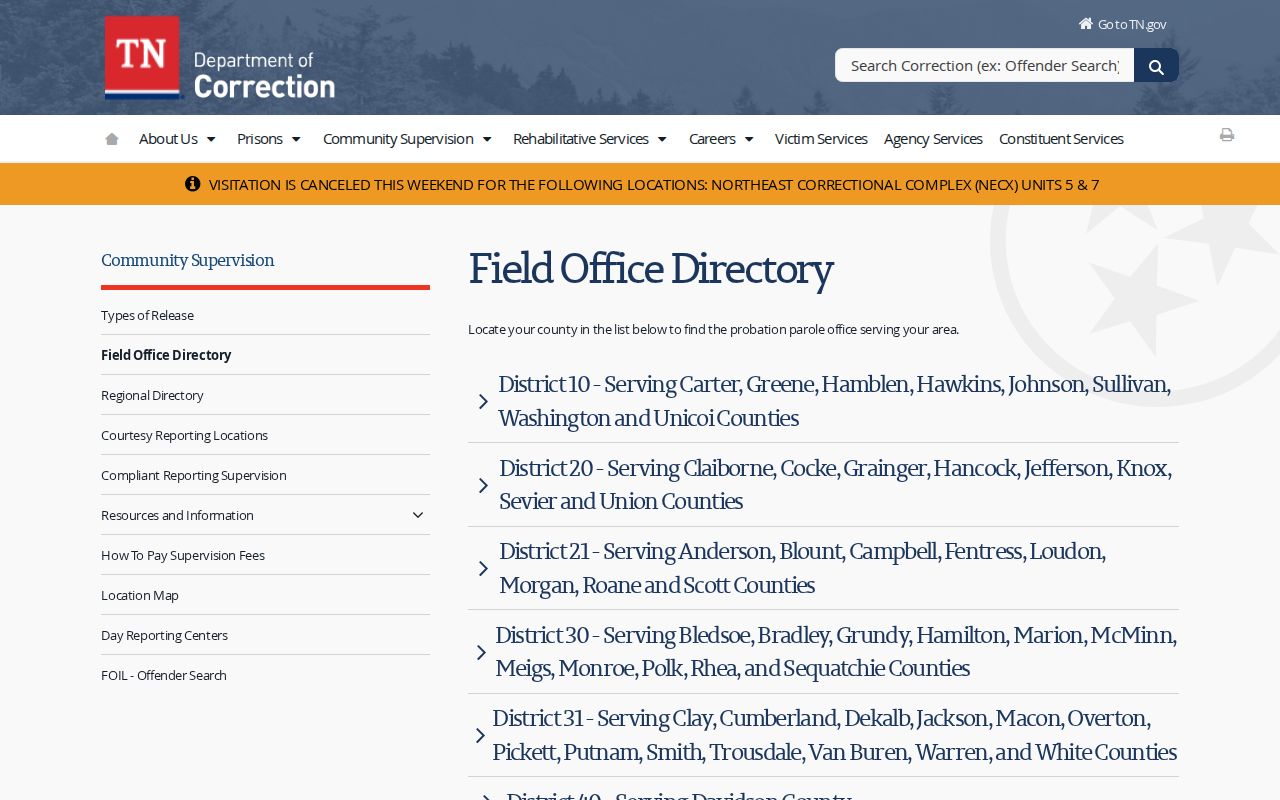
The listing links Dyer and Lauderdale counties to one Field Services office and supplies the current public contact details.
Dyer Parole Agency Split
The Board and TDOC answer different questions. The Board schedules hearings, receives a hearing officer's nonbinding recommendation, and issues the final parole decision. Its schedule is refreshed each Monday, or Tuesday after a Monday holiday. A line on that schedule means a hearing is planned. It does not mean parole was granted. Even a grant can precede release while the certificate, approved plan, recalculation, or another hold remains unfinished.
TDOC Field Services takes over routine supervision after physical release. FOIL can show status and possibly a location, but a public result should not be used to publish a home address or private reporting instructions. When the Board result matters, request the existing final decision or permitted hearing file through the Board of Parole public-record process. Common labels include granted, denied, deferred or continued, rescinded, and revoked. Report only the wording on the actual decision.
The Board's public page gives context for the decision stage. The Parole Hearings Division overview explains the Board role and its update cycle.
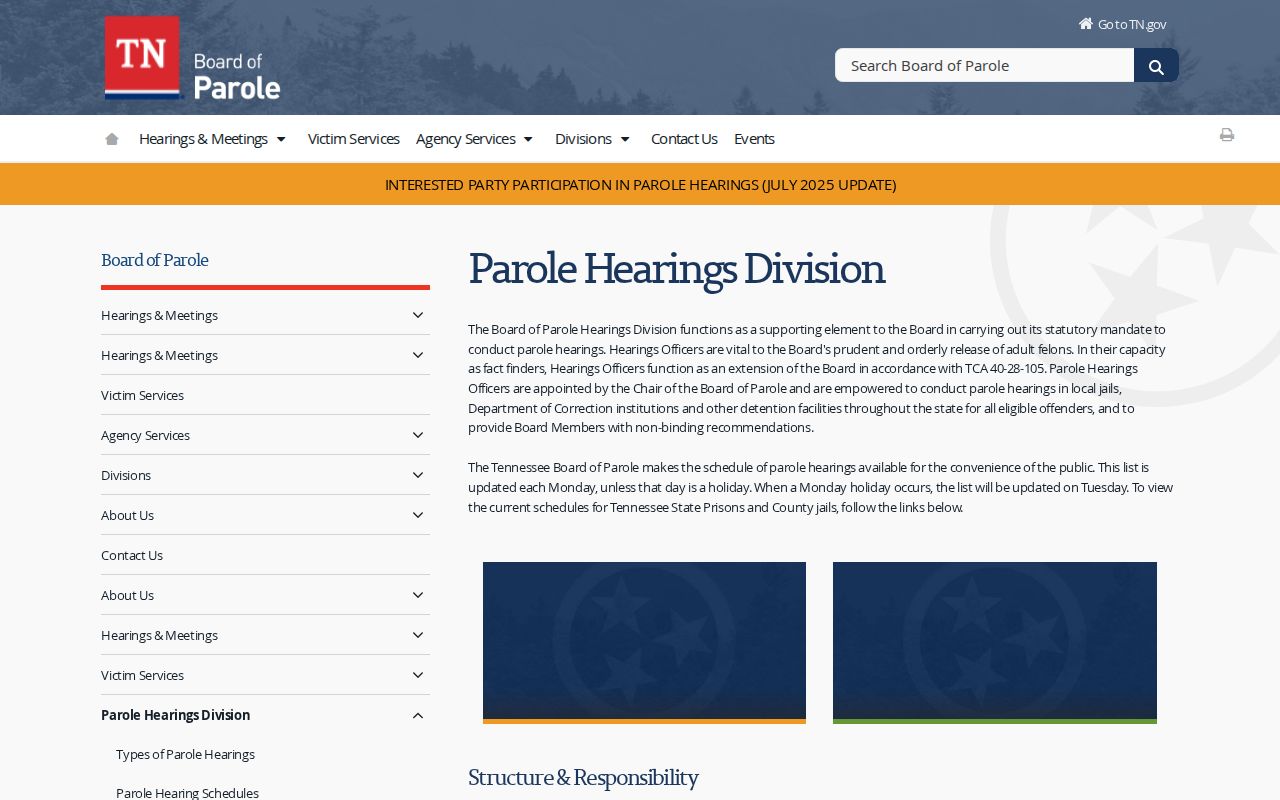
This division of duties is why one office cannot answer every Dyer County parole question.
Note: A Board grant, a parole certificate, physical release, and the first Field Services report are separate record events.
Dyer Supervision Violations
Conditions are the enforceable rules in the parole certificate or probation order. They may include reporting, treatment, residence, travel, payment, and conduct requirements, but the person's own document controls. A public summary is not a substitute. An alleged violation also is not the same as a final finding. TDOC can begin supervision action, while a court or the Board may have a separate role in the outcome.
An absconder is a person alleged to have stopped required contact or whose location is unknown to supervision authorities. That label should come from TDOC, a court warrant record, or an official wanted notice. Absence from a public list does not prove that no warrant exists. VINE may send a custody event, but it is not a warrant database and cannot resolve a conflict between agency records.
- Parole
- Conditional community release authorized by the Board before sentence expiration.
- Probation
- Court-ordered community supervision that may replace or follow confinement.
- Absconder
- A supervision status alleging required contact has stopped or the person cannot be located.
- Revocation
- A formal action that can cancel community supervision after the required process.
- Discharge
- The lawful end of correctional custody or supervision, shown by an agency or court record.
If a current FOIL status, court warrant, and VINE event conflict, note the date and jurisdiction of each. Ask the agency that owns the underlying record to correct it. VINE relays source data; it does not decide whether a Dyer County probation warrant is valid.
Dyer Release ID and Property
Release paperwork, identity documents, and personal property depend on the custodian that held the person. TDOC's policy directory lists Policy 511.05 for Tennessee offender driver's licenses and state-identification-only licenses. It separately lists Policy 504.01 for personal property. Those policies create state-prison pathways. They do not establish what the Dyer County Jail does with property or local release documents.
A person leaving Dyer County Jail should ask the sheriff which items were recorded, returned, retained, or transferred. An error should be raised with the agency that owns the inventory. Someone released from TDOC should use the state policy and release staff. If the person transferred to another custodian, property may follow a different procedure. Keeping those routes separate prevents a state rule from being misquoted as a county practice.
The TDOC policy directory supplies the current state documents. Ask for the policy in force on the release date because revisions can alter steps.
Note: State identification and property policies do not prove the Dyer County Jail's local release procedure.
Dyer Supervision Discharge Records
Supervision ends through an authorized expiration or discharge, not merely because a public result changes. FOIL may move a former offender to inactive status. That is useful evidence, yet the linked dates and record context must show whether parole or probation ended. For a complete state history, TDOC archived records can include arrival and departure data, certificates, and discharge or expiration notations, subject to redaction and lawful access limits.
Probation completion can also require the court file. Obtain the judgment, later orders, and any discharge entry from the proper Dyer County division. Parole completion rests on the TDOC and Board record. If exact terms are disputed, the order or certificate controls. A final discharge should not be confused with a short gap in public data, a move between offices, or a VINE delivery delay.
Tennessee public-record law gives qualifying access to existing government records, subject to exemptions. It does not require an agency to create a custom explanation. Ask for the named decision, certificate, status record, or discharge notation and provide the TOMIS number, full name, and date of birth when lawfully available.